The State of the Metris in the U.S.
As you may have heard, Mercedes-Benz has officially stepped away from the U.S. market for the Mercedes-Benz Metris—marking a major shift in the small van landscape.
In fact, all major players have now exited the compact van segment in the U.S., including Ford Motor Company, Nissan Motor Corporation, and Stellantis (formerly representing Dodge’s van lineup). It’s a clear signal that the market is evolving—and quickly.
For Mercedes-Benz, the decision largely came down to two key factors. First, the company is making a massive global push toward electrification, prioritizing investment in next-generation EV platforms. Second, the Metris relied on an engine built under contract with Nissan, and with that agreement coming to an end, it didn’t make long-term sense to renew. Instead, Mercedes has shifted focus toward developing future electric alternatives.
What This Means for Peace Vans
While the news marked the end of an era, it hasn’t slowed us down. As expected, demand remained strong through the final wave of builds—and it continues today.
We’re actively sourcing lightly used Mercedes-Benz Metris vans for customers, while also working with those who already own a Metris and are ready to convert. That flexibility has allowed us to keep this platform alive and well beyond its original production run.
That said, we are approaching a natural inflection point. As inventory becomes increasingly scarce, securing high-quality vans is getting more challenging—making each remaining build opportunity that much more limited.
Today, the Metris continues to hold its place as one of the most sought-after platforms for compact camper conversions. And while new chassis are no longer entering the U.S. market, we’re continuing to support and build on existing vans—keeping these vehicles adventure-ready for years to come.
Why is Mercedes discontinuing the Metris in the U.S.?
Mercedes-Benz announced plans to phase out the Metris van in the U.S. market as part of a broader global shift in strategy. While there has been plenty of speculation around the decision, the core reasons are fairly straightforward.
First, Mercedes-Benz is continuing its transition toward an electric future, prioritizing investment in next-generation EV platforms and commercial vehicles. As part of that shift, lower-volume internal combustion models like the Metris no longer align with long-term goals.
Additionally, the Metris relied on an engine produced under a third-party agreement. With that contract reaching its end, renewing it didn’t make strategic or financial sense—especially given the company’s pivot toward fully integrated, electric drivetrains.
Taken together, these factors made the decision less about any one issue and more about a larger evolution in how Mercedes-Benz is approaching the future of mobility.
Will Peace Vans stop converting Metris vans after 2023?
The Metris continues to stand out as one of the best platforms for camper van conversions—striking a rare balance between drivability, size, and capability. Demand hasn’t slowed, either. For travelers looking for a compact, fully capable camper, it still fills a niche that few other vehicles can match.
Looking ahead, our plan doesn’t stop when new inventory runs out. We fully expect to continue building on high-quality used Metris vans we source, keeping this platform on the road (and off the grid) for years to come. And, we love that customers are still bringing their vans in for conversions and/or upgrades.
What happens if my van needs maintenance down the road?
We get asked this question often, and it’s understandable: what if you need a new part five years later, but the van is discontinued? Luckily, there’s no need to worry about this. The U.S. National Highway Transportation Safety Board requires parts and services for discontinued vehicles to remain available for at least ten years past the last production date. Therefore, the Metris will be serviced through 2033. With the U.S. Postal Service owning 45,000 vans, they will likely be in service for many years (our mail carrier still drives a 1984 AMC mail van!). The vehicle is also top-rated in Europe and other parts of the world, so finding parts will never be an issue. We expect future iterations to share many features with the existing platform.
If you are still unsure, remember you can always purchase a 5-year/100,000-mile warranty (free with a new Peace Vans camper van purchase through the end of 2023) or even a 7-year/140,000-mile warranty for the van to extend the 3-year/36,000-mile standard warranty.
Speaking of the van market, we typically tell our customers not to view their camper vans as an investment. Like most vehicles, these products are depreciating assets. However, if you’re a Volkswagen Vanagon owner, you might disagree; because new Vanagons aren’t available anymore, they still sell for a decent price despite being old vehicles with many miles. Nothing is guaranteed, but we wouldn’t be surprised to see a similar trend with the Metris. Our Mercedes Metris camper van conversions are very niche and will be hard to come by in a few years.
What type of van will you convert after the Metris supply runs out?
While the Mercedes-Benz Metris has been a core part of our lineup, our approach moving forward is focused on adapting to what’s actually available—and what works best for our customers. We are, and always will be, in the business of building camper vans—it’s part of our DNA. And as the market evolves, so are we.
We will continue converting Metris vans for as long as we can source quality inventory. At the same time, we’ve begun building and refining camper conversions on the Volkswagen ID. Buzz, giving us a real-world understanding of how electric platforms perform in a camper setting.
Today, that evolution is already taking shape with the Volkswagen ID. Buzz. We’ve begun producing camper conversions on this new electric platform, marking an exciting next chapter for both our team and our customers. It brings together iconic design with modern EV technology, and we see massive potential as we refine what electric van life can look like.
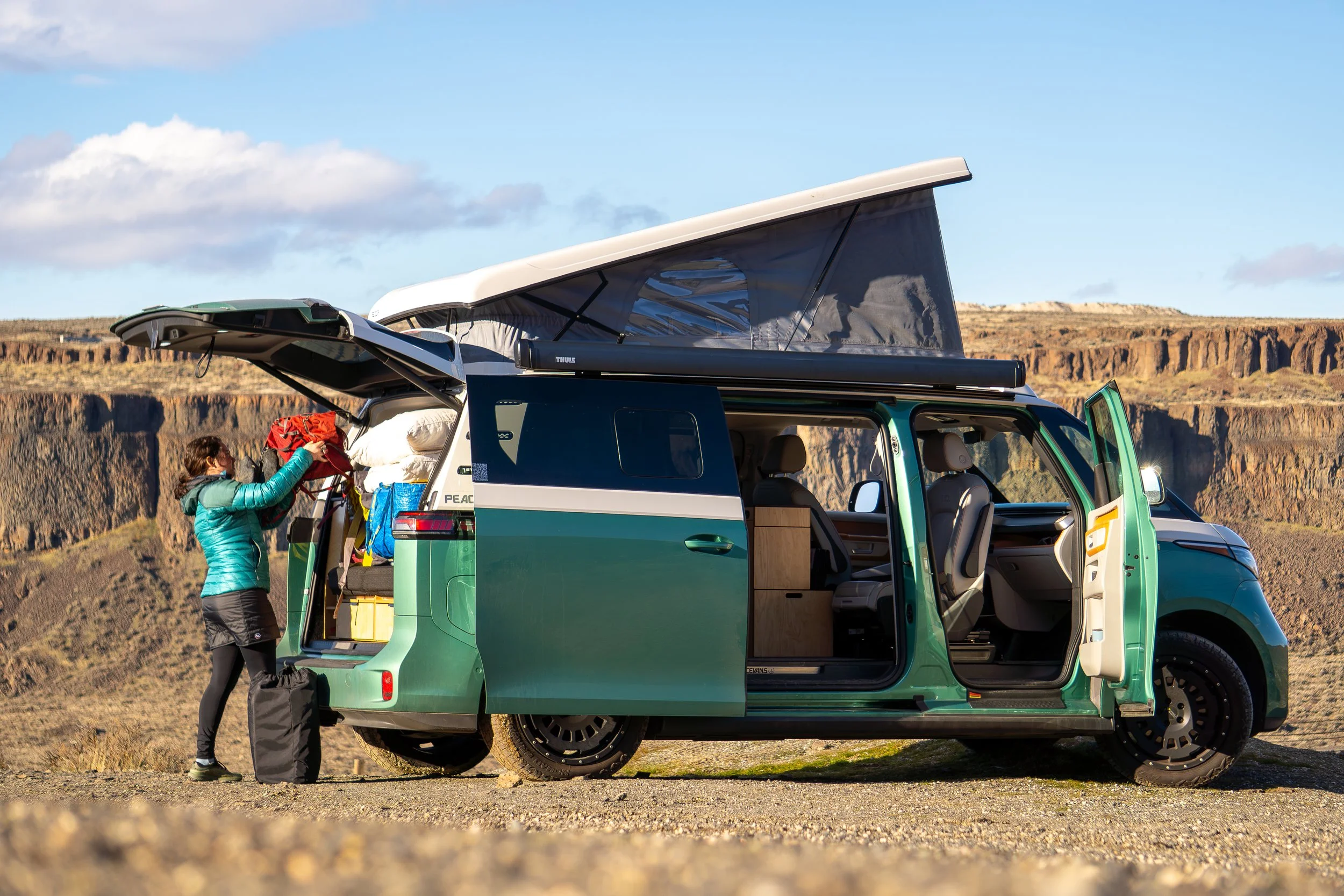
That said, the transition to electric isn’t without its challenges. Range, charging infrastructure, and overall usability for off-grid travel are still catching up to where traditional camper vans have been for years. While EV technology is improving rapidly, there are still real considerations when it comes to long-distance and remote camping. That doesn’t mean EV campers aren’t viable—it just means they require a different kind of trip planning. For shorter trips, regional travel, and campgrounds with reliable access to charging, platforms like the ID. Buzz can be a great fit. In fact, check out our Peace Vans Ambassadors and Digital Nomads Taylor and Zervan who are traveling all 48 states in their ID.Buzz!
Looking ahead, we’ll continue to explore multiple platforms—electric and beyond—while keeping a close eye on what manufacturers release next. If Mercedes-Benz brings an electric Metris-style van to market, we’ll absolutely take a hard look. But for now, the ID. Buzz represents a meaningful step forward—and a glimpse into the future of camper vans.




Why should I check out the ID Buzz (VW’s electric van)?
We were lucky enough to get early access to the Volkswagen ID. Buzz, and from the start, we saw real potential in what it could become as a camper platform.
Early on, we focused on two key directions: a modular kitchen box with a sleeper setup designed to fit seamlessly into the rear of the van, and a more complete camper solution featuring a pop-top. Both approaches allow us to work within the platform’s existing constraints while still delivering a functional and enjoyable camping experience.
Since then, we’ve moved forward with designing, testing, and refining these builds—and we’ve been extremely happy with the results. These solutions offer flexibility for a range of travel styles, from weekend trips to more extended adventures, without overcomplicating the platform. Check out what we’ve been doing here.
Today, we already have several dozen converted ID. Buzz vans out on the road with happy customers, and many more builds in the pipeline. As we continue to learn and iterate, we’re excited about what this platform can offer—and how it fits into the broader future of camper vans.
When is the latest I can order a Metris camper van?
The window to get a Metris camper with certainty is closing. As we mentioned above, the quantities are limited. It’s hard to say when we will stop doing conversions on them, but most likely by late 2026.
What else will Peace Vans do?
Peace Vans has been around 12+ years, and we fully expect to be around for at least that long, if not longer. We are a successful business with multiple things—vintage, electric, rentals, sprinter upgrades, etc. And we even have a few more things up our sleeve.
I need more information before filling out an order form.
No problem! Our website is full of information—we recommend starting on our Modern home page and then checking out the features of our conversion styles. Feel free to reach out if we still haven’t answered your questions!